Photographing the Cinque Terre
The Cinque Terre gives you more colour per frame than anywhere else in Italy. Apricot, rose, ochre and a sea-green gone chalky with salt, stacked five and six storeys above harbours the size of a tennis court. It also gives you five villages on a cliff with no flat ground, no road worth driving, and one railway line doing all the work. Those two facts decide how a shoot runs.
The colour does half the job, then fights you
Those facades are limewash, and limewash bounces. Put a couple in a narrow carruggio between an ochre wall and a raspberry one and you get two terracotta faces, unevenly lit, neither the colour of the person standing there. Recoverable in the grade up to a point, and then not.
Keep the colour behind the subject, not beside them. Shoot from the harbour mouth, the breakwater, a terrace looking back: the village becomes a wall of colour behind two people, soft if you open the lens up, and the face is lit by open sky or water. In the alleys, hunt the pale stretches near the church: those behave.
Clothing follows. Solid colours — cream, white, deep navy, black, olive, rust. Patterns lose against those houses, and so does anything in the paint's own family: a coral dress in Manarola disappears into the facade behind it.
Three frames that carry the whole coast
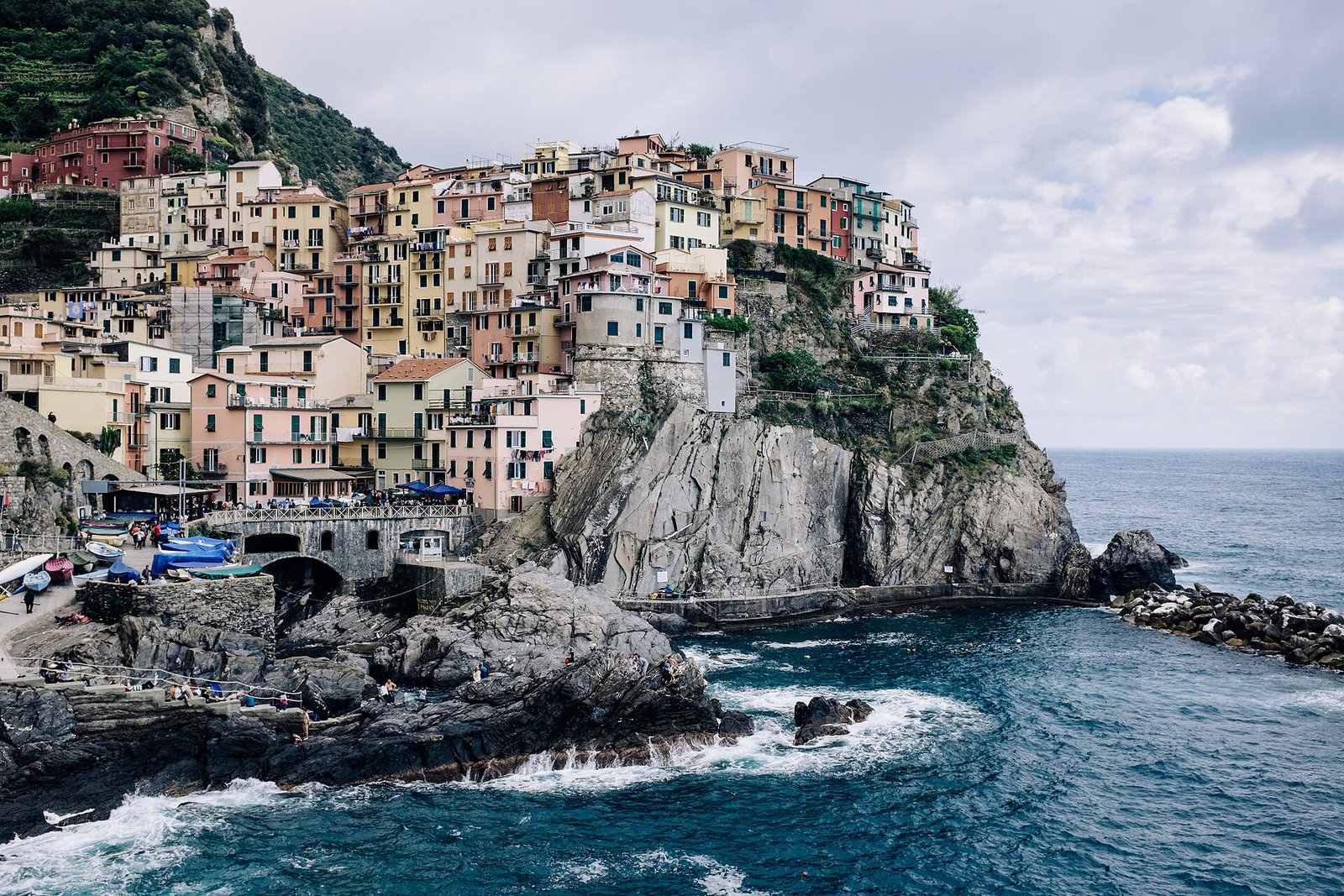
Manarola at dusk
The one everybody has seen, and it earns it. Leave the village past the marina and climb towards Punta Bonfiglio. The Nessun Dorma terrace sits along the way; the rocky ledges just below it are free and less contested. From there the village stacks up in front of you, fronts to the open water, so the last of the sun rakes the facades instead of arriving from behind.
The shot is not at sunset but twenty to thirty minutes after, when the village lights come up and hold level with the sky. Be in position an hour early: the walk is short, but in summer that ledge is a wall of tripods. From 8 December to the end of January the terraced hillside above the village carries Mario Andreoli's illuminated presepe, spread across the fasce. It changes the frame completely and is reason enough for a winter trip.
Vernazza from the castle path
Two options, not equivalent. Castello Doria inside the village is a cheap climb, a tower and a view straight down into the harbour bowl. The better frame is the first few minutes of the trail towards Monterosso: five minutes of steps out of Piazza Marconi and Vernazza opens below — curved harbour, tower, Santa Margherita d'Antiochia with its feet in the water. That stretch is inside the ticketed part of the Sentiero Verde Azzurro, and the checkpoint sits at the foot of the steps: you need a card even to walk up and back.
Last hour of light. The bowl opens southwest, goes gold, then goes matte inside about ten minutes. Build the composition before it arrives, not while it is happening.
Riomaggiore's main street
Via Colombo runs downhill from the station side to the marina, a canyon of shuttered houses in its own shade most of the day. That is the gift: soft, even light at eleven in the morning, nobody squinting. At the bottom it opens onto the slipway where the boats are hauled up on the concrete, and that is the picture — two people walking down, colour closing in from both sides, sea at the end of it.
At first light the only company is whoever is going out to fish. By ten you queue to walk down it.
Timing: sunrise, or the last hour
These villages are small enough that a hundred extra people ruin them. Day-trippers arrive on the trains from La Spezia and Levanto from about half past nine and drain away after seven. Everything before and after belongs to you.
Sunrise is the honest recommendation, with one correction to the almanac. The hills stand directly behind the villages, so at the stated hour you are working in open shade under a lit sky — even, flattering, streets empty. Direct sun arrives when it clears the ridge half an hour later, on the top floors first. Both halves are worth having.
In June that means being in position around half five: brutal, and worth it for Riomaggiore and Manarola to yourself, boats going out, first light across the roofs. In late October sunrise is around half seven, which is civilised.
Evening works, with one constraint. You get an hour, not three: each village sits in a notch with a headland to its west, so the light leaves the houses long before the sun is near the horizon. The sea still glows; the village has gone flat. Plan one village per session, two only if they are adjacent and you accept a quarter of an hour on a platform.
| Village | Best window | Effort |
|---|---|---|
| Monterosso al Mare | Sunrise, old town and beach | Flat, the only easy one |
| Vernazza | Last hour, from the trail above | Five minutes of steps |
| Corniglia | Any time, it stays quiet | 382 steps, or the shuttle bus |
| Manarola | Twenty minutes after sunset | Short climb, crowded ledge |
| Riomaggiore | Sunrise on Via Colombo | Steep street, then the slipway |
Move by train, not by car
The train is not the budget option, it is the correct one. The Cinque Terre Express runs every fifteen to twenty minutes in season and the hop between adjacent villages is two to four minutes of tunnel. The car is the mistake people make once: the high road is single lane with mirrors on the corners, parking sits far above the houses and costs more than the train, and at Riomaggiore and Manarola you walk down a long hill and back up it with the bags. Monterosso is the only village where arriving by car is not a punishment.
Buy the Cinque Terre Treno card for the day and build a twenty-minute buffer into any sunrise plan: the regional trains run late often enough to matter.
Ferries link four of the villages in season — Corniglia sits on its cliff with no harbour — and the water gives a different picture entirely. They stop in rough sea, and the last sailing is well before the good light.
What clients say about this kind of shoot
Wonderful experience! We loved having Marco as the photographer for our special day. He and his son had such warmth about them and made us feel comfortable. The delivery of the photos was so quick and we absolutely love the outcome! He captured all the smiles, tears, laughter and love while being so professional, gentle and discreet. We had a bit of a language barrier which made the interactions even more fun. He was supportive through all our requests with a smile on his face. Grazie Marco! Thank you for being a part of our wedding and blessing us with your talent!
— Neriana F. on Marco M.
Professionalism, availability, kindness and incredible care over every detail. They captured all the most beautiful and spontaneous moments of our daughter's christening, giving us memories we will treasure forever. We're so happy we chose them! ✨ Highly recommended!
— Alice V. on Cristian U.
My husband and I are simply blown away by how amazing the photos of our wedding in Tuscany turned out! They are unique, artistic, truly special and edited to perfection. We loved working with them and highly recommend them to anybody getting married or having a special event in the area.
— Alexandra S. on Marco M.
He was the photographer at our wedding, where he proved patient, discreet and above all always available... he's now our go-to photographer!
— Sara A. on Cristian U.
Choosing Marco and his team for our wedding was one of the best decisions we could have made! A fantastic photographer, extremely good and professional. From the very first moment he made us feel completely at ease, and on the wedding day he was impeccable in every respect. He managed to catch emotions, details and spontaneous moments without ever being intrusive, telling the story of our day in an authentic, special way. The photos are wonderful and every time we look at them we're moved all over again, reliving those unique moments. We'd choose him a thousand times over!
— Barbara A. on Marco M.
Much more than a photographer — where his photographs end, the memories begin! I've known Marco Miglianti since I was a child. He photographed my First Communion and my Confirmation, so when the time came to choose a photographer for our wedding we had not the slightest doubt: we already knew it would be him. And today we can say with absolute certainty that we couldn't have made a better choice. From the very first meeting Marco won us over with his irresistible warmth, his humanity and his ability to put us completely at ease. He is a sunny, genuine person, always with a smile. On the morning of the wedding, as the emotion and the nerves were starting to bite, he managed to turn it all into laughter, calm and lightness. It was like having a family friend beside us. From the first moment Marco understood us perfectly, without our having to explain. We didn't want forced poses or staged moments; we simply wanted to live every instant spontaneously, without feeling watched or directed. With the discretion and sensitivity that set him apart, he managed to tell the story of our day exactly as it was: authentic and full of real emotion. With that same discretion and sensitivity he caught the knowing looks, the embraces, the tears of joy, the laughter and all those small details that often slip past but are the essence of such a special day. He never once asked us or our guests to interrupt a moment to pose, and precisely because of that, every photograph tells the truth of that day. When we received the photos we were deeply moved. We weren't simply looking at images: we were reliving our wedding. Every shot took us right back to that instant and those feelings, and made us feel something incredible. That is the greatest gift a photographer can give. Beyond his extraordinary sensitivity, Marco is an exceptionally well-prepared professional. You immediately sense his experience, his care for every detail and his ability to handle any situation calmly and confidently. Even his famous bride's emergency kit shows how nothing is left to chance and how much he genuinely wants everything to be perfect. Thank you from the heart, Marco, for telling the story of the most beautiful day of our lives with your enormous passion, your sensitivity and your infectious smile. You gave us authentic, timeless memories that we will keep in our hearts forever. If we could go back, we would choose you again. And we'd do it a thousand times over! Martina & Florian
— Martina B. on Marco M.
The paths close, and it is not negotiable
After heavy rain the park shuts trail sections by ordinance, sometimes for a day, sometimes for a season. This is a coast that slides: the closures are real and they carry fines. Check on the morning of the shoot, not the week before. Via dell'Amore, the low path between Riomaggiore and Manarola, runs on timed entry with limited slots — book it, and carry an alternative for the day it is shut.
Drones are a flat no: national park and UNESCO site. A tripod on the Manarola ledge at dusk is normal; the same tripod in an alley at midday gets you moved along. A ceremony needs a permit from the comune, and there are three here — Monterosso, Vernazza with Corniglia, Riomaggiore with Manarola — each on its own timescale.
Stairs, and what they do to the day
Everything is stairs. Not a picturesque flight of six: hundreds, uneven and worn slick. Flat shoes, and a bag with the good ones for the frames that need them. A long dress plus wind on the breakwater is a combination to plan for, not discover. If anyone cannot manage steps, build the session around flat Monterosso and the water end of Riomaggiore.
When to come
Late May and early June: green terraces, the longest days, the sea still cold. Late September into mid-October is the best trade — warm sea, low light, the crowd thinning after the first weekend of October, rain a real risk. August is the one month I would talk someone out of. Winter is empty and the light off the water is remarkable, but restaurants close, ferries stop, and the storms throw salt spray over Riomaggiore's marina and your front element.
Booking a session
Sessions start at EUR 450 for one hour and EUR 680 for two, all in, or from EUR 405 through Quick Booking. One hour covers one village properly at sunrise or dusk. Two hours suits couples who want a second backdrop, since part of it goes on a train. For a proposal, the Manarola ledge at dusk is the postcard but crowded; the Vernazza trail in the last hour is quieter and the reveal is bigger.
More on the villages on the Cinque Terre page. For the same Ligurian palette with yachts instead of stairs, Portofino is about ninety minutes away — train to Santa Margherita Ligure, then the bus round the headland, since no railway reaches Portofino.
Frequently asked questions
When is the best time to photograph Manarola?
Not at sunset but twenty to thirty minutes after, when the village lights come up and hold level with the sky. Be in position on the rocky ledges below the Nessun Dorma terrace towards Punta Bonfiglio an hour early, because in summer that ledge is a wall of tripods. From 8 December to the end of January the hillside above the village carries an illuminated presepe, which changes the frame completely.
What should you wear for a photoshoot in the Cinque Terre?
Solid colours – cream, white, deep navy, black, olive, rust. Patterns lose against the limewashed houses, and so does anything in the paint's own family: a coral dress in Manarola disappears into the facade behind it. Wear flat shoes for the hundreds of uneven, worn-slick steps and carry the good ones in a bag for the frames that need them.
Should you get around the Cinque Terre by train or by car?
By train: the Cinque Terre Express runs every fifteen to twenty minutes in season and the hop between adjacent villages is two to four minutes of tunnel. The high road is single lane with mirrors on the corners, parking sits far above the houses and costs more than the train, and Monterosso is the only village where arriving by car is not a punishment. Buy the Cinque Terre Treno card and build a twenty-minute buffer into any sunrise plan.
Want professional photos in the Cinque Terre?
Browse portfolios, compare packages, and book a verified local photographer in minutes.