A Solo Portrait Photoshoot in Italy: How It Actually Works
It is less exposing than it sounds
Almost everyone who books a solo session writes some version of the same sentence first: I've never done this, I'm not photogenic, I have no idea what to do with myself. Twenty minutes into the shoot the same person is asking whether there's time for one more street. The distance between those two states is shorter than it looks, and it closes mechanically rather than emotionally.
Two things do the work. The first is that nobody you know is watching. No partner shifting their weight, no friend holding a phone, no running joke you have to keep up with. Strangers in an Italian city are the least interested audience on earth: tourists point cameras at each other all day, and one person standing still in a lane is the least remarkable thing on it. The second is that the photographer is a stranger you will never see again, which turns out to be freeing instead of awkward.
That is most of what solo sessions are — someone travelling alone, or travelling with people who take bad pictures, who wants a set of images of themselves that were not taken at arm's length.
The first ten minutes
We walk. The first frames are walking frames on purpose — nothing to hold, nothing to hit, no instruction more complicated than go to that door and come back. Those frames usually get deleted. That is what they are for.
Somewhere around minute six or seven your face stops performing. You can feel it happen: the shoulders drop, you stop checking whether the last one was okay. That is when the real frames start, and a photographer worth the money is watching for that moment rather than working down a checklist.
What actually helps before then:
- Take the first slot of the day. Not only for the light — there is no audience at 7am.
- Eat something first. Hunger sits in the jaw and it shows.
- Bring three reference images, not forty. Be able to say what you like about each one.
- Say out loud what you dislike in photos of yourself: a side, a chin, a smile you don't trust. Anything can be shot around once it has been said, and nothing can be shot around while it is a secret.
- Decide in advance who is going to see these. It changes what you wear, and it is an easier decision over coffee than in the middle of a street.
Hands
Hands are the whole problem of solo portraits. In a couple's session hands have somewhere to go. Alone, they hang, they go symmetrical, they flatten against the thigh and spread out like paddles.
Give them a job:
- Hold something with weight. Coffee cup, gelato, book, jacket over one forearm, folded sunglasses, a bag strap. Weight relaxes the wrist.
- Touch your clothes, not your body. Collar, cuff, hem, pocket. Thumb hooked in a pocket with the fingers outside is the single most useful hand position that exists.
- Break the symmetry. One hand busy, one hand loose. Two hands doing the same thing reads as a school photograph.
- Keep the palm hollow. A flat, tense hand shows up in an image the way a tense voice shows up on a recording.
- Move slowly. Hands to the hair are fine, but at dawn the shutter is slower than you think and fast hands smear.
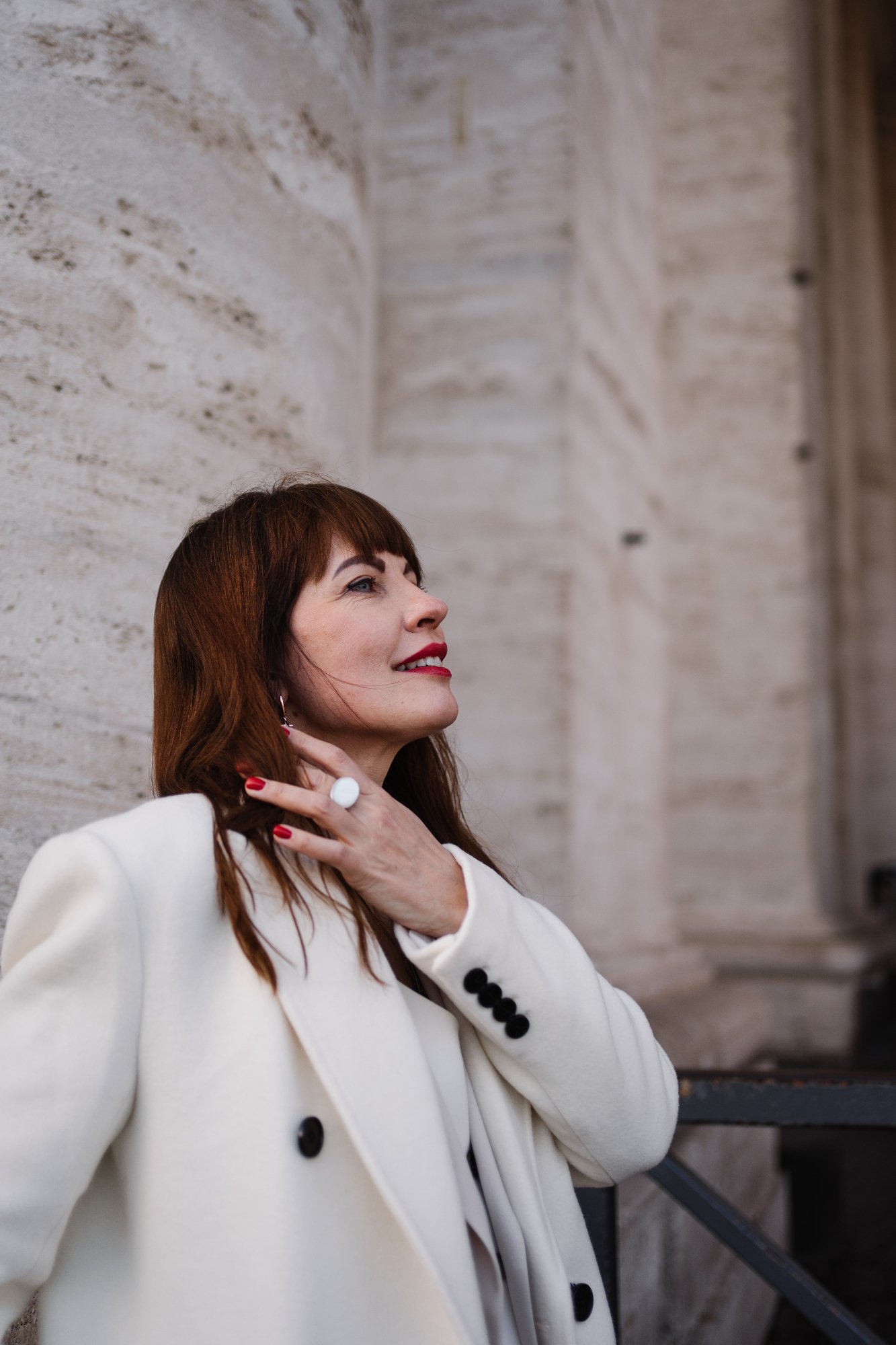
Touching your own face works with fingertips only, barely landing. Pressing a palm to your cheek changes the shape of the cheek and it always looks like it.
Where to look when there is nobody to look at
Eyes drift when they have no target, and drifting eyes are the difference between a portrait and a passport photo. Blur gives them nothing to hold. Pick a physical object every time.
- Down the lane you just walked. A door number, a shutter latch, a hanging basket. It produces a natural three-quarter turn instead of the flat, chin-forward face.
- About thirty degrees off the lens. Not "away" — away reads as avoidance. Just off, at something real.
- Straight into the lens, used sparingly. Four or five frames out of a hundred. It is the strongest thing in the set and it stops working if it's everything.
- The reset. Close your eyes, drop the chin slightly, breathe out, open on a count of three. It kills the strain that builds after about thirty seconds of holding an expression.
Keep something in motion, too. Walk, turn, adjust a sleeve, look back over the shoulder. Total stillness in the body stiffens the face within seconds.
Cities that suit a solo session
Rome — narrow lanes that bounce light
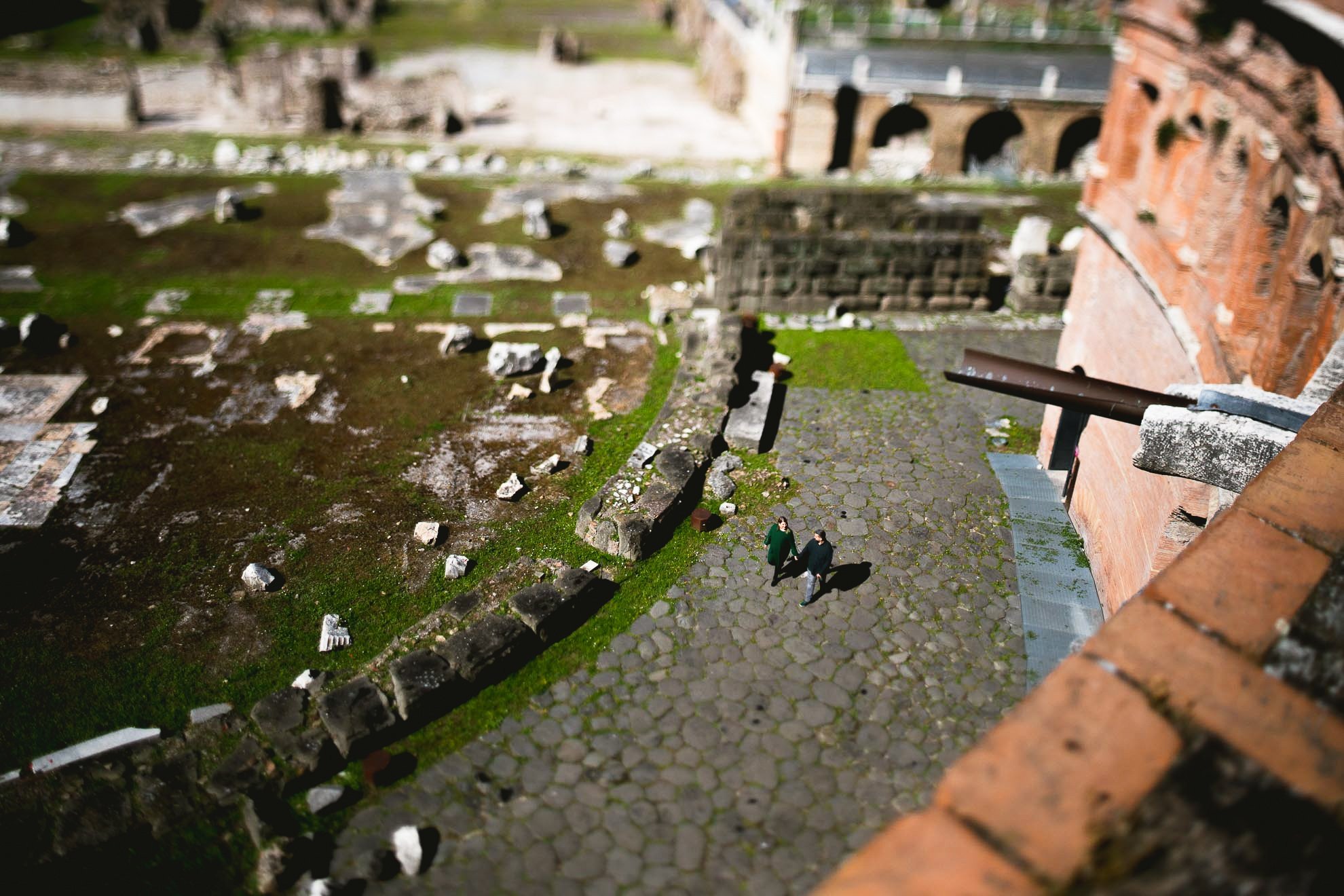
Rome is built of five-metre-wide streets with warm plaster on both sides, which means the light bounces sideways into the face instead of falling straight down from above. Monti, the lanes behind Piazza Navona, Trastevere before nine. It suits solo work because the frames are close and one person fills them: someone standing in a lane with a parked Vespa and a doorway is a portrait, not a landmark snapshot. Rome is also busy enough that you are completely anonymous. The cobbles are not decorative — flat shoes for walking, heels only for the standing frames.
Florence — bridges in the first twenty minutes
Florence is compressed: Duomo to Ponte Vecchio to the water is a fifteen-minute walk end to end, so one hour buys three backdrops. The Arno runs roughly east to west, so at sunrise the light comes straight up the river with nothing to block it. Stand on Ponte Santa Trinita facing the Ponte Vecchio and you get backlight, burning water and the hanging houses in silhouette. There is a real window of about twenty minutes when the bridges are empty, and then there isn't.
Venice — Dorsoduro, not the Rialto
Venice is impossible in the wrong places and perfect in the right ones. Dorsoduro is the right one. The Zattere faces south across a canal wide enough that the far bank shades nothing, so it takes low morning sun down its whole length. On Rio San Trovaso, the squero where gondolas are still built and repaired gives you wood, water and no crowd — shot from the fondamenta opposite, because it is a working yard, not a set.
Venice enforces its rules. You cannot sit on bridges or steps, you cannot block a calle, tripods get moved along, and anything that looks like a production — lights, an assistant, a stand planted in Piazza San Marco — needs permission first. A solo shoot fits inside all of that easily, because one person and one camera never stop moving. Check the access fee before you travel, too: on busy dates the city charges day visitors to come in.
A white town in Puglia
Whitewashed limestone is a giant reflector: shadows fill themselves and the light under the chin stays open long after it would have gone ugly elsewhere. In Alberobello, Rione Monti at seven in the morning is stone, cone roofs and nobody at all; by ten it is a souvenir street with coaches at the top. The trade is real — you get the town to yourself or you get the town.
A portrait trip is not a content shoot
These are two different jobs, and booking one while expecting the other is the most common way a session disappoints.
| Portrait trip | Content shoot | |
|---|---|---|
| Goal | frames you would print | volume, variety, verticals |
| Outfits | one, maybe two | three or more, planned |
| Pace | slow, one neighbourhood | tight, many backdrops |
| Framing | horizontal and vertical | 9:16 with headroom for text |
| Needs from you | willingness to be quiet | a written shot list |
A portrait trip asks almost nothing of you except that you arrive rested and let it be slow. A content creator session asks for preparation: a written list of shots tied to actual posts, outfit changes bagged in the order they will be worn, props that need to appear, and someone — you — willing to be ruthless about the clock.
An unhurried hour of portraits produces a gallery you would print from and only a handful of usable verticals. Say which job it is when you book and the whole shoot is built differently from the first minute.
Practical
- One hour, from 345 EUR all-in — one neighbourhood, one look, no changes.
- Two hours, from 520 EUR — two areas and a change of clothes.
- Three hours, from 920 EUR — across a city, sunrise into full morning or afternoon into blue hour.
A few things specific to travelling alone: agree on a named public meeting point rather than a corner, tell someone at home the plan and the time, and keep your own luggage — a shoot is not a bag drop. Rain is not a cancellation either. Wet stone reflects, umbrellas are props and the streets clear out, which for a solo session is close to a gift.
Come with a rough idea of what you want the pictures for. Everything else — hands, eyes, where to stand, when to shut up — is the photographer's problem, and it should feel that way by minute ten.
Frequently asked questions
How do you prepare for a solo photoshoot in Italy?
Take the first slot of the day, because there is no audience at 7am; eat something first, since hunger sits in the jaw; bring three reference images, not forty, and be able to say what you like about each. Say out loud what you dislike in photos of yourself – anything can be shot around once it has been said – and decide in advance who is going to see the pictures, because it changes what you wear.
What should you do with your hands in a solo portrait?
Give them a job: hold something with weight – a coffee cup, gelato, a book, a jacket over one forearm – or touch your clothes rather than your body, with a thumb hooked in a pocket and the fingers outside. Break the symmetry with one hand busy and one loose, keep the palm hollow, and move slowly, because at dawn the shutter is slower than you think.
Where should you look during a solo photoshoot?
At a physical object every time, because drifting eyes turn a portrait into a passport photo: down the lane you just walked, at a door number or a shutter latch, or about thirty degrees off the lens at something real. Look straight into the lens only four or five frames out of a hundred. When strain builds, close your eyes, drop the chin, breathe out and open on a count of three.
Want professional photos in Rome?
Browse portfolios, compare packages, and book a verified local photographer in minutes.