Honeymoon Photoshoot in Italy: Where to Go and When
An Italian honeymoon almost always takes one of three shapes: the lakes, the coast south of Naples, or Tuscany. The shape decides more about your photographs than the photographer does, because each has a constraint built into it — a ferry timetable, a single-lane cliff road, or two usable hours of light with an hour of driving in between.
Here is what each is like to work in. How a session itself is structured is on the honeymoon session page; this is the where and the when.
The lakes: still water in the morning, early shadow at night
Lake Como
Lake Como is the most photogenic of the three and the most awkward to move around in. It is a narrow trench with mountains going straight up on both sides, and that geometry runs your day.
Direct sun leaves the water 45 to 60 minutes before the official sunset, dropping behind the western ridge first. What follows is a long, soft, blue-tinted light that is lovely and is not golden hour. The eastern shore — Varenna above all — faces west and holds the last warm light on its facades. The western shore, Tremezzo and Lenno, goes into shade first and is at its best in the morning, once the dawn breeze drops and the water is glass. The Breva comes up from the south around midday; by three the lake is choppy and a boat is a bouncing platform, so put anything on the water in the morning.
Then the ferries. Varenna to Bellagio is a quarter of an hour by boat and an hour or more by car around the Lecco branch, on a road one nervous lane wide through the villages. Plan on the timetable, not the map, and check the off-season columns: the last useful crossing can be before dinner. If the day crosses the lake twice, a private boat taxi costs less than the time you lose without one.
Villa del Balbianello, book before you book the hotel
Balbianello belongs to FAI, the national trust, not to a hotel, so you cannot simply turn up with a photographer. Anything beyond personal snapshots needs permission in advance, slots are limited, there is a separate fee that goes to the villa, and it shuts for the winter — roughly mid-November to mid-March, plus Mondays and Wednesdays in season. Good dates go months ahead and weddings take priority, so confirm the villa before the hotel. Access is a kilometre of lakeside path from Lenno or a boat to the villa's dock; in heels the path is not an option.
Lake Garda
Lake Garda forgives more. Wide enough that the shadow problem disappears, it has two characters: the low, olive-and-limestone south around Sirmione, and the cliff-walled north around Limone and Malcesine. At the tip of the Sirmione peninsula the Grotte di Catullo are ticketed and shut on Mondays; the rock shelves below them are free, empty at seven in the morning and unusable from ten. Garda also has real wind — the Pelér from the north in the morning, the Ora from the south every afternoon, reliably enough that it is a windsurfing lake — so plan hair and veils. It sits half an hour from Verona, which makes a city-plus-lake day easy.
Amalfi and Capri: the road is the constraint
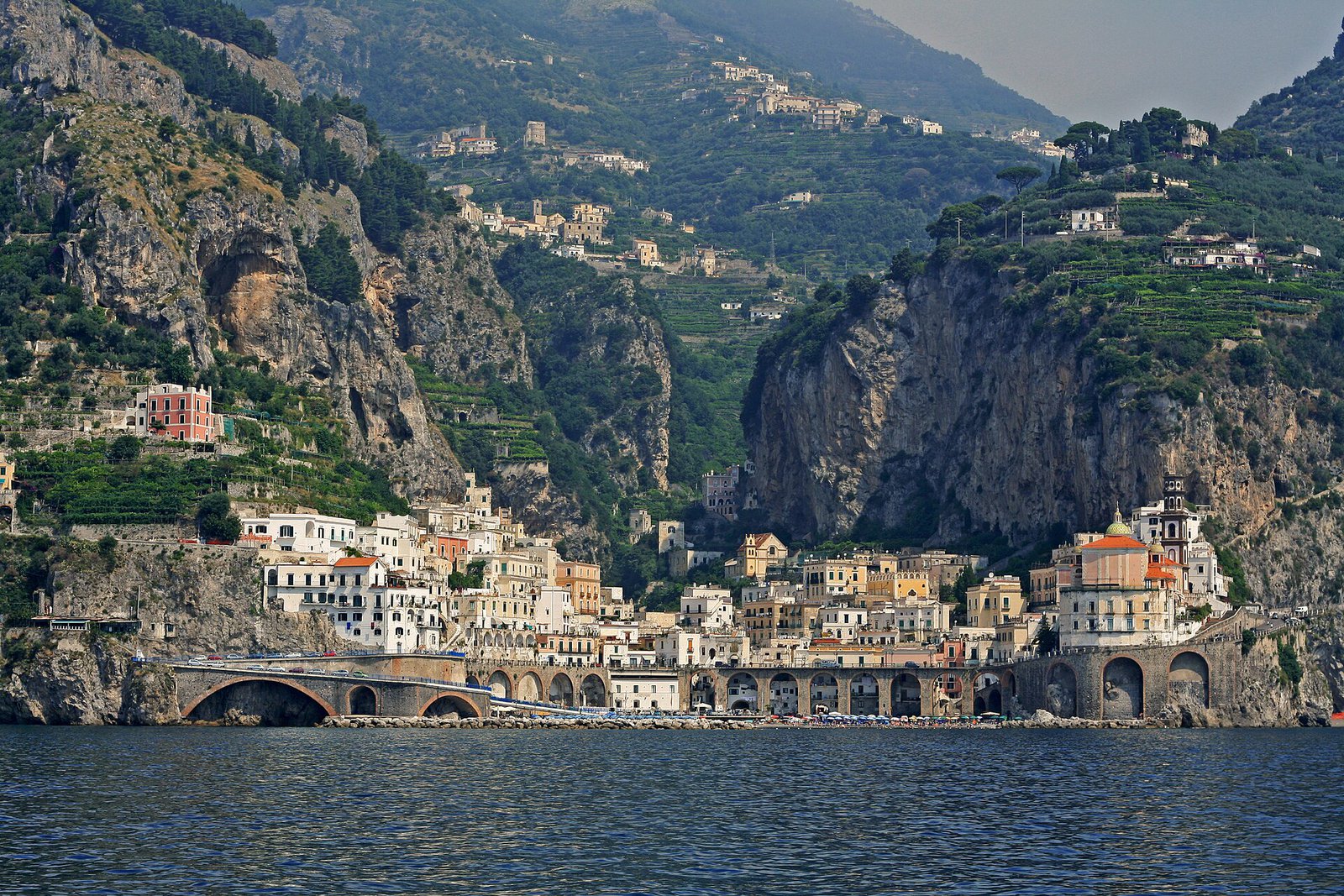
The Amalfi Coast is not far. It is slow. The coast road is one lane each way, cut into a cliff, shared with full-size buses that reverse at the tighter corners. In August twenty kilometres can take an hour and a half, and some summers bring alternating number-plate restrictions in daytime hours. If you are going in August, build the plan around not driving between nine and seven. From spring to autumn the passenger ferries between the coastal towns are faster than the road.
Positano faces south and stacks up a mountainside. The picture everyone wants — the town spilling towards the majolica dome of Santa Maria Assunta — is taken from the road above, and works until about half past eight. After that the road is stationary and the viewpoint has a coach parked in it. It is also several hundred steps top to bottom: flats on, good shoes in the bag, no route up the whole town.
Ravello sits 350 metres up: cooler air, and the haze below you rather than around you. Villa Cimbrone's Terrace of Infinity opens at nine and fills within the hour, so it is an opening-time location or nothing. Cimbrone and Villa Rufolo are ticketed and have their own rules about photography beyond a phone snap — ask before you turn up in a long dress.
Capri runs on the tide of day visitors: they land between ten and eleven and are gone by half past five. Sleep on the island and the Faraglioni view from the Punta Tragara belvedere — free and always open — is yours at seven in the morning and again after six. The Gardens of Augustus are ticketed and open at nine, so they are an opening-time stop, not a sunrise one. Day-trip in from Sorrento, twenty-odd minutes by fast ferry, and you shoot in exactly the worst window. Cars are restricted: funicular, bus, open taxi, steps — everything on Capri is uphill, and Via Krupp is often shut after rockfall.
Tuscany: you are going to drive
Tuscany is the only one of the three where the honeymoon is a road trip. Nothing is next to anything else: Florence to San Quirico d'Orcia is about an hour and forty minutes, with Siena in between.
City and countryside want opposite hours. Florence is a dawn city — the Ponte Vecchio and the Oltrarno lanes are yours until about eight — while Piazzale Michelangelo faces the city, so it is an evening view and a crowded one. Val d'Orcia is dawn and dusk only: at midday in summer it is hazy, flat and thirty-five degrees, and nothing there is worth photographing. The reward for getting up is late September and October, when fog sits in the valley floors and the cypress ridges float above it — which means being at the viewpoint at half past six, in the dark.
The colour changes by month, which catches out anyone who booked from a photograph: green until April, poppies in mid-May, tall gold wheat in June, cut stubble by early July, brown and ploughed through August and September, green again after the autumn rain. If you want the golden wheat, you want June.
Two practical things. The white gravel roads dust everything, so change at the car and walk the last stretch in flats. And Florence and Siena both have camera-enforced traffic zones; the fines arrive months later through the rental company.
Siena also has a calendar rule: around 2 July and 16 August, Piazza del Campo is a racetrack, earth laid over the brick and grandstands up for weeks either side. Worth seeing. Useless as a backdrop.
What clients say about this kind of shoot
Wonderful experience! We loved having Marco as the photographer for our special day. He and his son had such warmth about them and made us feel comfortable. The delivery of the photos was so quick and we absolutely love the outcome! He captured all the smiles, tears, laughter and love while being so professional, gentle and discreet. We had a bit of a language barrier which made the interactions even more fun. He was supportive through all our requests with a smile on his face. Grazie Marco! Thank you for being a part of our wedding and blessing us with your talent!
— Neriana F. on Marco M.
My husband and I are simply blown away by how amazing the photos of our wedding in Tuscany turned out! They are unique, artistic, truly special and edited to perfection. We loved working with them and highly recommend them to anybody getting married or having a special event in the area.
— Alexandra S. on Marco M.
Choosing Marco and his team for our wedding was one of the best decisions we could have made! A fantastic photographer, extremely good and professional. From the very first moment he made us feel completely at ease, and on the wedding day he was impeccable in every respect. He managed to catch emotions, details and spontaneous moments without ever being intrusive, telling the story of our day in an authentic, special way. The photos are wonderful and every time we look at them we're moved all over again, reliving those unique moments. We'd choose him a thousand times over!
— Barbara A. on Marco M.
Much more than a photographer — where his photographs end, the memories begin! I've known Marco Miglianti since I was a child. He photographed my First Communion and my Confirmation, so when the time came to choose a photographer for our wedding we had not the slightest doubt: we already knew it would be him. And today we can say with absolute certainty that we couldn't have made a better choice. From the very first meeting Marco won us over with his irresistible warmth, his humanity and his ability to put us completely at ease. He is a sunny, genuine person, always with a smile. On the morning of the wedding, as the emotion and the nerves were starting to bite, he managed to turn it all into laughter, calm and lightness. It was like having a family friend beside us. From the first moment Marco understood us perfectly, without our having to explain. We didn't want forced poses or staged moments; we simply wanted to live every instant spontaneously, without feeling watched or directed. With the discretion and sensitivity that set him apart, he managed to tell the story of our day exactly as it was: authentic and full of real emotion. With that same discretion and sensitivity he caught the knowing looks, the embraces, the tears of joy, the laughter and all those small details that often slip past but are the essence of such a special day. He never once asked us or our guests to interrupt a moment to pose, and precisely because of that, every photograph tells the truth of that day. When we received the photos we were deeply moved. We weren't simply looking at images: we were reliving our wedding. Every shot took us right back to that instant and those feelings, and made us feel something incredible. That is the greatest gift a photographer can give. Beyond his extraordinary sensitivity, Marco is an exceptionally well-prepared professional. You immediately sense his experience, his care for every detail and his ability to handle any situation calmly and confidently. Even his famous bride's emergency kit shows how nothing is left to chance and how much he genuinely wants everything to be perfect. Thank you from the heart, Marco, for telling the story of the most beautiful day of our lives with your enormous passion, your sensitivity and your infectious smile. You gave us authentic, timeless memories that we will keep in our hearts forever. If we could go back, we would choose you again. And we'd do it a thousand times over! Martina & Florian
— Martina B. on Marco M.
Marco and his whole team shot my wedding and I was genuinely struck by their professionalism and by the beauty of the photos they took for us! Ours tell every moment of our wedding perfectly — shot after shot they gathered up our entire day! ❤️ Heartfelt thanks to Marco and all his team.
— Irene on Marco M.
I came across Marco's photos by chance on Instagram, even before I met my wife. His photographic style stayed with me until, a year ago, the moment finally came to contact him — successfully — for my wedding. Marco, his wife and his son are fantastic; you can see they love their work and do it with passion. They made us all feel at ease, creating a relaxed atmosphere and capturing, discreetly but attentively, truly every instant, with an artist's eye and a great deal of heart. The result of their work is the photos and the video we had dreamed of… beautiful memories we will keep forever.
— David B. on Marco M.
When each is at its best
| Where | Go | Avoid |
|---|---|---|
| Lake Como | Mid-May to mid-June, September | August crowds; mid-Nov to mid-March, villas shut |
| Lake Garda | May, June, late September | The August holiday week, when the south end is solid |
| Amalfi and Capri | Late April to early June, mid-September to October | August on the coast road; Nov to March, much of Capri closed |
| Tuscany | June for the wheat, late September and October for the fog | July and August middays, which are unusable |
Watch the long weekends: 25 April, 1 May and 2 June fall inside the best window, and on those the coast road, the ferries and the car parks behave like August. If none of the three fits, add two nights of Venice: arrive the night before, shoot at half past six while the day boats are still crossing the lagoon.
How long a session actually needs to be
An hour, from EUR 345 all in, covers one location and one look: a village, a terrace, a stretch of shore. Two hours, from EUR 520, is the honest minimum if you want to move at all — harbour and old town, or the villa and the water. Three hours, from EUR 920, is for days with a boat, a ferry, or two towns on the Amalfi road, where travel eats a third of the clock before anyone raises a camera.
Beyond duration, cost moves on logistics rather than postcode: how far the photographer travels, how many people are in the frame, how many edited images you want, whether you need a boat, and whether the location charges its own access fee. Balbianello does, and that money goes to the villa.
The through-line is the same in all three: the good hour is early, and one thing usually has to be booked before everything else. Put that in the calendar first and let the honeymoon arrange itself around it.
Frequently asked questions
When is the best time for a honeymoon photoshoot on Lake Como?
Mid-May to mid-June and September; August brings crowds, and from mid-November to mid-March the villas are shut. On the day itself put anything on the water in the morning, before the Breva comes up from the south around midday, and remember that direct sun leaves the lake 45 to 60 minutes before the official sunset.
How do you plan an Amalfi Coast photoshoot in August?
Build the plan around not driving between nine and seven: twenty kilometres of coast road can take an hour and a half, and some summers bring alternating number-plate restrictions. From spring to autumn the passenger ferries between the coastal towns are faster than the road. The classic Positano frame from the road above works until about half past eight in the morning.
Which month is best for photos in the Val d'Orcia?
June for the tall gold wheat, late September and October for the fog that sits in the valley floors while the cypress ridges float above it – which means being at the viewpoint at half past six, in the dark. The colour changes by month: green until April, poppies in mid-May, cut stubble by early July, brown and ploughed through August and September.
Want professional photos on Capri?
Browse portfolios, compare packages, and book a verified local photographer in minutes.